SBP on Facebook SBP Facebook
WCRS slots:
   
In-stock slots: 0 Week of May 27: 0
Next refresh: June 3, 9am Eastern
Please read at left for explanation!

This week's message:

I've started using the sewing slot system again. I hate to do it, but I simply can't keep up with the order volume that's been consistently high for months now. Please click the link for an explanation of how it works and why I need to use it.

At right, In-stock slots are for fabrics I have on hand (basic and organic fabrics) and will be sewing from scratch; WCRS slots are for things you're having sent to me like wrap pieces, custom fabric, or sling shoulder redos. Next refresh is the date and time I will be adding more sewing slots.

I've changed from sewing a mix of WCRS and in-stock slings each week, to just doing WCRS one week and in-stocks the next. I think this will be more efficient and allow me to sew more slings, and may also may sewing slots easier to get. Sewing slots for both types will be added every other week, in a several batches to give people in different time zones the opportunity to order. If these present a difficulty for you, please email me at info@sleepingbaby.net and let me know.


Contents:

  1. Precautions and warnings
  2. Threading the sling
  3. Putting the sling on
  4. Positions:
    1. Cradle hold and Nursing in the cradle hold
    2. "Football" hold for nursing
    3. Tummy-to-tummy hold and Nursing in the t2t hold
    4. Kangaroo/front-facing
    5. Back carry
    6. Hip carry
  5. Other usage suggestions
  6. Troubleshooting
  7. Folding your sling for storage/travel

Hip carry:

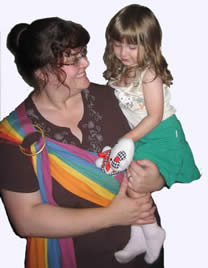
This is terrific for older babies (those with good head/neck control) all the way up through toddlerhood. Depending on the size of your baby, you will probably be able to start hip carrying him between 6 and 9 months of age. Sophia is almost three in these pictures, and still loves to be carried in the sling.

Tighten up the bottom of the sling so that it makes a pouch for her to sit in. Then start by holding the child on the shoulder opposite the rings, as though you were going to burp her.

Keeping one hand on her bottom at all times, slide her legs into the sling (a little trickier for toddlers; you'll need to bend their legs and tuck them in).

Your baby's legs should straddle your hip, just as though you were carrying her without a sling. Ideally, her bottom will be a little lower than her knees, and the sling fabric should be snugged up just behind her knees. This way, her weight is held by her bottom, not her legs; that's more comfortable for both of you.

Spread the fabric out over your child's back. If you are slinging an older baby or need to keep your toddler's hands contained, it should go over his shoulders. For toddlers who can have their hands free, around the armpits will suffice. You can start in this position for a toddler back carry as well, or shift him around more towards your front for nursing.

Of course, this isn't just for babies (or even toddlers)! I don't do it on a regular basis, but Stephen (now 6) still occasionally requests a sling ride himself when he's really tired.

Next: Other ideas


site design (c) 2001-2013 by sleeping baby productions llc. Logo design by Molly Fisher, Fisher Illustration and Design.
All content is (c) 2001-2013 to Jan Heirtzler/Sleeping Baby Productions LLC and may not be reproduced without permission.