Cradle hold:
In light of the CPSC warning about using slings with babies under 4 months,
particular caution needs to be taken with this position. Your baby should never
be horizontal in the sling -- I know you've probably seen celebrity photos where
they have their babies totally horizontal, with their faces hidden in the fabric,
but that's totally a "what not to do" scenario. The ideal position in a cradle
hold is actually more of a partial recline. The baby's body should be diagonally
inclined in the sling, with her head clear of the fabric so that her chin isn't
forced onto her chest, and you should always be able to clearly visualize her
mouth and nose for safety. Grunting and snoring noises that occur only in this
position are a sign that she is having trouble breathing and should be repositioned
at once.
This position is fine for infants and small babies who don't yet have head
control. Some babies like to nap in this position, and it is among the easiest
for nursing. However, lots of babies don't like this position, so don't give
up on your sling if yours is one of them! Also keep in
mind that your baby's airway needs to be straight (her chin should
not rest on her chest, as that can impair her breathing). If your baby seems
swallowed up in the fabric, or has difficulty breathing due to being too scrunched
up, fold up a receiving blanket and put it in the sling before you put baby in. Or
better still, use the "tummy to tummy" carry, which does not carry
the same airway risks as a cradle hold.
Decide which side you want her head to be on. If you are petite, there may
not be enough room across your body for you to have her head on the same side
as the rings. On the other hand, if you are larger like me, you may prefer to
have her head on the same side as the rings. I almost never wore my babies with
their heads opposite the ring end, except when I was breastfeeding them. However,
my petite friend was just the opposite!
|
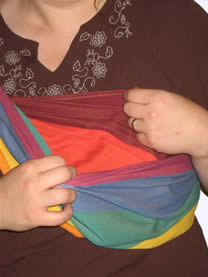
Put the sling on as you normally would, and then pull the bottom edge upwards
on your chest so that you've formed a pouch with the sling. You'll want the now-inner
edge to be nice and tight, so pull on the part of the tail that corresponds to
that edge (if your sling isn't twisted, it will be the outside edge of the tail).
You may wish to start with the rings a little bit higher than the corsage position,
as they can move slightly when you tighten the sling later. |
|
If you want her head on the side opposite the rings, cradle
her with your opposite arm, just as you would if you weren't wearing the sling.
Starting from a vertical position will help you get her in a safe, partially-reclined
position, rather than the potentially unsafe full recline. |
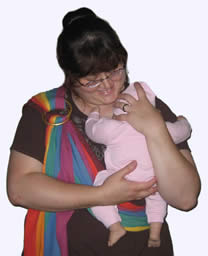 |
Open the sling with your other hand, and slip the baby into the pouch with
your arm still around her. Keep supporting her head if she is a newborn. |
 |
Supporting her head with the hand on the same side as the rings, slip your
arm out from underneath her. Now you can tighten the sling. |
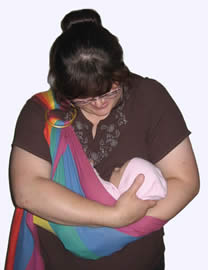 |
It's also important to make sure that the fabric is not covering
the baby's face, and that she's not too deep in the pouch. Her neck should be
in a neutral position -- not tipped far back or forward or sideways -- to keep
her airway clear, and her mouth and nose should be clear for breathing (not squashed
into your breast). You can tuck a small pillow, rolled-up fabric, or the sling's
tail under her upper back if her chin tends to dip to her chest, but tightening
the middle part of the sling will also help. |
 |
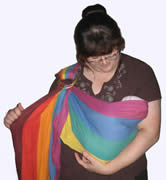
You will need to tighten the upper and lower edges -- and
even the body of the sling -- independently, by pulling on each in turn. If the
sling is difficult to adjust, you can hold the rings apart slightly with one
hand, while pulling with the other. The series of pictures below shows first
adjusting the top rail, then the bottom (inside) rail, and then the body of the
sling (if the baby feels too deep in the sling).
  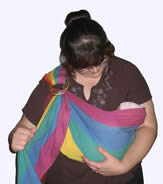
If you are unused to the sling, it is a good idea to adjust
it while you are sitting down, to minimize the potential risk to the baby should
it slip. Until you feel confident in wearing your baby, it is helpful to keep
an arm around the baby in the sling. |
The technique is similar for the cradle hold with the baby's
head on the same side as the rings, but you will want to start with her head
at least 4" from the rings, to avoid having them touch her head when the
sling is fully adjusted. It's also a little easier to do a semi-sitting position
with her head on the ring side. |
Nursing in the cradle hold:
You can nurse with the baby on either side relative to the
rings; smaller-breasted people may prefer to nurse on the ring side, while larger-breasted
people may prefer the opposite. Being the latter, I don't have pictures of the
former, but the technique will be essentially the same.
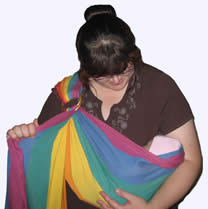
Cradle the baby with her head away from the rings.
Pull the sling around her,
so that her feet stick out the end (tiny infants may keep their feet in the sling,
but Sophia is 6 weeks old in these pictures and is already too long for that).
Adjust the fabric around her bottom and sides so that she is secure. |
 |
You may want to cover the back of your baby's head with the sling in
order to keep her secure, but if you will be holding her with your non-dominant
arm, it's not strictly necessary. Tighten the sling until you are both comfortable.
It will probably be significantly tighter than in the normal cradle hold. You
may need to loosen the lower edge while tightening the upper edge. It is a good
idea to practice this while sitting down, for safety's sake. |
 |
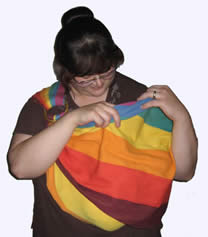
You can use the sling tail to cover your chest, if you desire. This is
most helpful when you are learning to chestfeed in the sling, or when you are
getting things set up. It is especially useful for infants who are easily distracted
when nursing in public, as the cover can keep her eyes, and your breasts, covered
up :) However, you *must* be sure that you can still see her mouth and nose while
she is nursing! When I nursed in a sling, I would wear a v-neck shirt and pull
the shirt down around my breast for nursing. Then (or usually, at the same time),
I used the sling tail to cover my breast up to about the baby's mouth, so that
I can still clearly see her and check her breathing and position frequently.
It is *never*
safe to completely cover your baby while she is nursing. It doesn't matter
how many times you've done it, there is always potential for something to go
wrong. Unfortunately, babies have smothered (even outside of slings) while chestfeeding
(their mothers thought they were just sleeping), so you really need to be able
to see what's going on. It's one thing to be discreet while you're nursing, but
please put safety before modesty!
After she is finished, even if she's gone to sleep, gently move her into a
vertical (tummy to tummy) position. |
 |
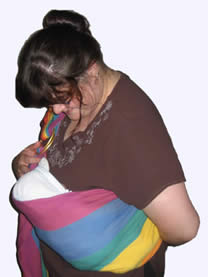
"Football" hold for nursing:
For nursing in the football hold (especially helpful after a c-section),
start with the rings high on your shoulder. Place the baby in a cradle hold,
with her head about 8-12" from the rings (depending on your size and build – smaller
people will need less distance than larger people). The goal is for her head to
end up at nipple level when she is shifted backwards in the next step. |
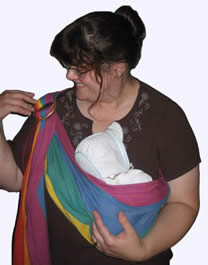 |
Hold the rings with your ring hand and support the baby's weight with your
other hand. Gently pull the rings down at the same time you move the baby around
towards your back. (This is a good maneuver to get familiar with in other positions,
too; supporting your baby's weight is key for moving the sling and keeping the
tension correct.) The rings should end up in corsage position and the baby's
head in the proper position for nursing. Please remember to check your baby frequently. I have my arm out of the way in the photo, but I don't recommend hands-free nursing for the reasons above. It's better to have your baby's head free of the fabric so that she can unlatch or clear her airway as she needs to, and supporting her head with your hand will fascilitate that. Supporting her head with fabric means it can be difficult or even impossible for her to move her head away your body, which is a suffocation risk. |
 |
Just a note... when you're first learning how to chestfeed in a sling, it's
tricky to do it hands-free. When you're just starting out,
and with a tiny newborn, I recommend keeping your arm inside the sling, supporting
the baby's head as you would when nursing without the sling. Once your baby has
better head control, and you're more comfortable with the sling, you can have
your arm in the sling when getting latched on, then take out your arm once the
baby is latched on correctly. Having even one hand free (as the sling will take
most of the baby's weight) can be a major help when you're newly post-partum
and trying to get things done!
Next: Cuddle hold

Copyright © Jan Andrea Handmade 2022