Back to Baby Crafts | To HTML
(color) version of these directions | To my home page
A Simple, Un-Padded Tube-style Sling (Revised
11/5/2005)
Interesting note: the curved-seam pouch was invented by Hygenia
Halfmoon, who then showed the method to Nancy Main, who started "New
Native". Now many pouches for sale are labeled "Native-style" even
though they are a very recent innovation (certainly not actually Native American),
dating back to the 1970s with Hygenia's book "Primal Mothering in a Modern
World". My thanks to Jenrose for
this tidbit.
Materials needed:
- Fabric: Between 1.5 and 2 yards of fabric, depending on your size;
the most you will need is 2 yards, unless you are built very large.
- This works fine with polar fleece!
- See the Fabric FAQ for specific fabric recommendations
and online sources
- Sewing machine and thread to match/contrast with the fabric. You could sew
this by hand, but unless you don't have a machine, I wouldn't recommend it!
- Time: under 1 hour, even if this is your first project!
Before you begin, you'll need to know how long to make the sling. My initial
pouch-style sling was based on my ( then) brand-new MayaWrap pouch. At the time,
I found that their large pouch was a bit too small for me, and wanted to make
one to fit. I used the MW as a sort of vague pattern, adding a couple of inches
to the length. Since then, I have made my own modifications to the pattern --
it's no longer a direct copy. These directions should help you figure out the
best size for you.
 Most
pouch-style slings are shaped so that the upper, open portion is shorter than
the lower, folded portion. This makes measuring for one a little tricky, since
the place you measure will impact the final size of the pouch, and therefore,
how well it fits. In this revision of my directions, I would recommend measuring
from your collarbone to about 4-6" below the opposite armpit -- all the
way around, if you can manage that. (You *could* just take the front measurement
and double it, but that doesn't take into account variances due to, um, boobage
and the like.) then take another measurement from just below the point of your
shoulder (or wherever you would like the lower edge of the pouch to rest) to
your side at about hip level and back up again. The black lines in the picture
at right approximate the curve the pouch will take when worn with a baby in a
cradle hold. ( the grey lines show how the fabric will likely spread across your
back.)
Most
pouch-style slings are shaped so that the upper, open portion is shorter than
the lower, folded portion. This makes measuring for one a little tricky, since
the place you measure will impact the final size of the pouch, and therefore,
how well it fits. In this revision of my directions, I would recommend measuring
from your collarbone to about 4-6" below the opposite armpit -- all the
way around, if you can manage that. (You *could* just take the front measurement
and double it, but that doesn't take into account variances due to, um, boobage
and the like.) then take another measurement from just below the point of your
shoulder (or wherever you would like the lower edge of the pouch to rest) to
your side at about hip level and back up again. The black lines in the picture
at right approximate the curve the pouch will take when worn with a baby in a
cradle hold. ( the grey lines show how the fabric will likely spread across your
back.)
If you are currently pregnant, not to worry! You'll be measuring mostly above
the bump anyway, but if your tummy gets in the way, just subtract a couple/few
inches from the bottom/longer measurement. Most of the time, the difference between
the upper/shorter measurement and the bottom/longer measurement will be under
5". If the measurement is more than 5", I would recommend just using 5"
-- a deeper pouch will be more difficult to use in the long run, and may not
be as comfortable.
If all else fails, try experimenting by folding the fabric as shown in the
instructions below and pinning it in different places, until it feels right.
Again, err on the larger side.
| Worksheet |
Upper
(shorter) |
Lower
(longer) |
| Base measurement: |
|
|
| + seam allowance (2"): |
|
|
| + baby allowance (2-6"): |
|
|
| Final measurement (TLF): |
|
|
| 1/2 TLF (for cutting): |
|
|
Seam and Baby Allowances:
Obviously, you'll need to add a little length for the baby. I would start
pretty conservatively, adding 2-6" to each measurement; you can always take
the pouch in if it's too big, but it's more difficult to add more material once
it's done. Then, you'll need to take a seam allowance into account. I use an
enclosed seam on this project, because the double seam makes it extra sturdy.
Allow about an inch on either side for the seam allowance -- so add another 2" to
your measurements. You'll have the longer of the two measurements + 2-6" baby
allowance + 2" seam allowance. This is the total length of fabric you'll
need -- henceforth referred to as TLF.
Polar fleece caveats:
 |
 |
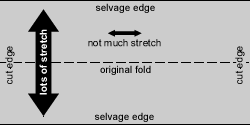
| Cutting stretchy fabrics -- always cut with
the majority of stretch going along the length of the carrier, not across its
width. |
Polar fleece usually has some stretch going from cut edge to cut edge, and
a lot of stretch going from selvage to selvage. Make sure you know
which direction is the stretchier one! My first polar fleece pouch was a
disaster because I had the stretchier direction going along the sling instead
of across it. It was always too tight when I had it on without Stephen in it,
and then stretched too much when I put him in. Also, you will probably find that
you can cut it to your actual around- the-chest measurement, instead of adding
a few inches, since it will stretch when you put the baby in. This goes for any
stretchy fabric.
When sewing with polar fleece (or other stretch fabrics), be sure to use a
stretch stitch. A simple zigzag is fine, or you can use one of the fancier stretch
stitches if your machine has them.
Pouch seam with fleece: in lieu of sewing a full French/flat felled seam as
below, you can just sew a sturdy seam (a couple of rows of zigzags, or another
stretch stitch), trim one side of the seam allowance to 1/4" less than the
other, and sew the wider seam allowance over the narrower one, again using a
stretch stitch. It's not quite as strong as the French/flat felled seam, but
it's plenty strong enough.
If you are using 54-60" fabric...
Cut the fabric so you have two pieces that are 1.5-2 yards long and 22" wide.
there will also be a long strip about 12" wide left over; you can use it
to make accessories, or make a child-sized sling to match yours -- pouch or ring
type :)
For 45" wide fabric...
You can either cut or fold it in half, so it's 22" wide. This works especially
well with calico prints; you can sew the edges together and then "quilt" the
layers for more strength. If your fabric is heavy enough without doubling, you
can cut it down the center fold and have two 22" wide slings. (Please feel
free to email me if this isn't clear
enough!)
For either width of fabric... |
Fold the fabric in half widthwise, then in half lengthwise:
(Image is intended to show all layers -- your fabric should be laid out more
neatly than this :) |
 figure
2 figure
2 |
To make the pouch sling truly pouch-like, you'll need to cut
a curve into the unfinished edges:
 the
lengthwise fold should be the longer measurement you took (plus the seam and
baby allowance), and the unfinished edge, once cut, should be the shorter measurement
(plus seam and baby allowances). the
lengthwise fold should be the longer measurement you took (plus the seam and
baby allowance), and the unfinished edge, once cut, should be the shorter measurement
(plus seam and baby allowances).
Note that the curve straightens out as it approaches the unfinished edge.
This will make hemming the edges a lot easier; I would recommend having a straight
section about 1.5" long to accommodate a 3/4" rolled hem.
For polar fleece, you can make the curve less pronounced. |
I also recently made a pouch that wasn't symmetrical around
the foldline. That is, it was higher on the outside than it was on the inside,
so that the fabric went up higher on Sophie's back than it did underneath her.
To do this, when you're making the "smile" cut above, just fold the
fabric so that it's not quite in half along that lengthwise fold -- one edge
will be higher up than the other. Draw your smile as above. The shorter part
of the fabric will only get part of the "smile". When it's done, this
makes the pouch a little more comfortable in the hip carry, but shouldn't be
used for an infant in the cradle hold. |
Next, unfold the lengthwise fold, and sew the new curved cut edges together.
You'll want to make this a very sturdy seam, as it will take all the strain.
A French seam
works well, as does a flat-felled seam
(like the ones on the legs of a pair of jeans). either way, it should look fairly
finished, as it may show when wearing the sling. |
 figure
4 figure
4 |
| Finally, fold the sling in half along the lengthwise again, so that the seam
you just sewed is on the inside and you have a tube of material with a fold on
one end and the curved seam on the other. Hem the unfinished edges separately.
To help the sling keep its shape while you wear it, make a very small tacking
stitch on the folded end, hemmed edge to hemmed edge (but wait until after you've
tried it on with the baby!). I hope this illustration is clear enough -- it's
supposed to show the tube shape, inside and out. |
 figure
5 figure
5 |
When you use the sling, the folded end will be at or near
your shoulder, and the baby's bottom should rest in the curved edge, the pouch
part, which will be between your hip and your chest (depending on where you want
the baby and how old s/he is). Try the sling on with your baby in it before you
put away the sewing machine. The baby should sit comfortably against your upper
torso. If s/he hangs too low, you may find that your back starts to hurt. If
the sling is too long, you can take it in along the shoulder -- the width-wise
fold. Unfold the lengthwise fold, so you have the D-shape as in figure 4, then
sew a seam along the widthwise fold. This is something you can take out later
as the baby grows.
the Peppermint
site has some pictures that make wearing clearer. |
Making a reversible pouch:
 This
is actually pretty simple. The easiest and safest way to do it is to cut your
fabrics to length as shown in the previous section, above. Here, the fashion
fabric is represented by the black and blue motif, and the inner/lining fabric
is bright blue. Stitching is shown in white. When cutting the curve, stack your
fabrics together, or cut one and then use it as a sort of pattern for the second
fabric. (That's probably the easiest if you're making a silk combination.) This
is actually pretty simple. The easiest and safest way to do it is to cut your
fabrics to length as shown in the previous section, above. Here, the fashion
fabric is represented by the black and blue motif, and the inner/lining fabric
is bright blue. Stitching is shown in white. When cutting the curve, stack your
fabrics together, or cut one and then use it as a sort of pattern for the second
fabric. (That's probably the easiest if you're making a silk combination.)
then, with right sides together, sew the two long edges, NOT the curved sections
just yet. |

Turn right-side-out, and topstitch the long edges.
Baste the curved edges, so they can be treated as one layer: |
 Now
you can sew the curve. Put your inside fabrics together and make a narrow seam
along the curve. Make sure all four layers of fabric (two of the outside fabric,
two of the inside) are caught in the seam! Try on the pouch and see how well
it fits. You'll be taking another inch in the next step, but it should be nearly
fitted with this step. If it's too large, make another seam parallel to the first,
as far from that seam as necessary. Now
you can sew the curve. Put your inside fabrics together and make a narrow seam
along the curve. Make sure all four layers of fabric (two of the outside fabric,
two of the inside) are caught in the seam! Try on the pouch and see how well
it fits. You'll be taking another inch in the next step, but it should be nearly
fitted with this step. If it's too large, make another seam parallel to the first,
as far from that seam as necessary.
You may need to trim some of the fabric inside that seam to make it about
3/8" wide. |
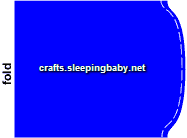
Turn inside out, and stitch about 1/2" from the previous seam -- this
makes a French seam. All the raw edges will be enclosed, making this a neat and
secure finish. You can either leave the seam as it is, sticking up a bit, or
sew it down. I would recommend sewing it down, but be careful as you sew, since
mistakes will show up on the outside of the pouch. |

Now fold your pouch in half as above, so that the inner fabric is inside,
and the outer fabric is outside. |
I made myself a pouch like this out of a prototype brocade/dupioni
ring sling that I wasn't wearing anymore. I did find that I wasn't happy wearing
a pouch as-is -- the uninterrupted swa the of fabric in front of me was irritating,
and it never stayed in place. I remembered seeing something I liked on someone
else's pouch sales page, though: they'd taken a strip of fabric and wrapped it
around the pouch, approximately where the rings would be on a ring sling. This
ga thers the material up, making a much more comfortable shoulder that stays in
place, and a less obtrusive swa the of fabric in front. I've looked around, trying
to find the inventor of this marvelous innovation in pouches, but I can't find
her site anymore. If you should happen to know where it was, please let me know!
 Anyway,
to make this strip, I used a 10" by 5" strip of my lining material.
Fold the strip in half lengthwise (so it's 10" by 2.5"), then sew the
raw edges, leaving a small space for turning. Turn right side out, and topstitch
the edges. I put two snaps on each end to make it removeable, but it turns out
I didn't really need to; I always use the sling with this strip in place. You
can use Velcro™, snaps, or even a small buckle. If you don't want to use
fasteners, just make a longer strip initially and tie it instead, or use a piece
of ribbon or whatever. I find the pouch to be far more comfortable and useful
with this in place. Anyway,
to make this strip, I used a 10" by 5" strip of my lining material.
Fold the strip in half lengthwise (so it's 10" by 2.5"), then sew the
raw edges, leaving a small space for turning. Turn right side out, and topstitch
the edges. I put two snaps on each end to make it removeable, but it turns out
I didn't really need to; I always use the sling with this strip in place. You
can use Velcro™, snaps, or even a small buckle. If you don't want to use
fasteners, just make a longer strip initially and tie it instead, or use a piece
of ribbon or whatever. I find the pouch to be far more comfortable and useful
with this in place.
|
Back to Baby Crafts | To HTML
(color) version of these directions | To my home
page
All content, barring that which is otherwise attributed, is ©2023 to
Jan Andrea. If you wish to use my content on another page, please email before
doing so, even for content with the Creative Commons licenses. Text/images used
elsewhere must be attributed to me. Be advised that I will pursue copyright
violations.